Enhancing Capacities of Youths and Women for Local Governance Accountability in Ghana’s North-East Region

By Salifu Bayana Kumuriwor (MERL Coordinator, Simba Ghana)

Abstract

Good governance and accountability are essential for sustainable development, especially at the local level where decisions directly impact communities. In Ghana’s North-East Region, youths and women often face systemic barriers that exclude them from governance.

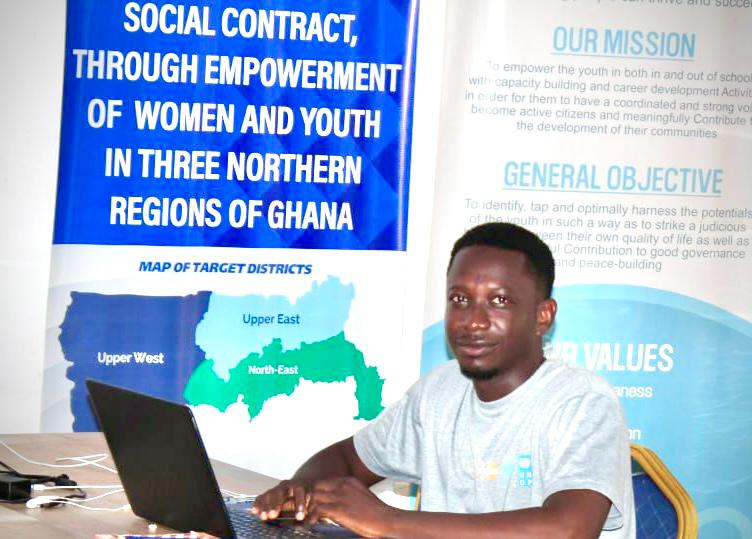
Simba Ghana, in collaboration with CDD-Ghana, under the UNDP Ghana and UNFPA Ghana-funded Peacebuilding Fund (PBF) Project, has worked to empower marginalized groups, foster inclusive governance, and reduce vulnerabilities to violent extremism.

This article explores the strategies, lessons, and impacts of Simba Ghana’s work across Yunyoo-Nasuan, Bunkpurugu-Nakpanduri, and Chereponi Districts.

Introduction

Local governance is the closest point of interaction between citizens and the state. Yet, in many communities, youths and women are excluded from decision-making due to cultural norms, lack of access to information, and weak institutions.

Simba Ghana’s PBF interventions aim to address these barriers through:

  • Capacity building,
  • Advocacy, and
  • Strengthening local governance systems.

Key Interventions

1. Capacity Building

  • 72 youths and women trained in social accountability tools.
  • Community Social Accountability Networks formed in 9 communities.
  • Community Action Plans integrated into Medium-Term Development Plans (2026–2029).

2. Strengthening Governance Structures

  • Training for 12 Area Councils.
  • Gender-responsive budgeting workshop for 75 policymakers.

3. Community Engagement and Advocacy

  • Radio and social media campaigns amplified governance issues.
  • Youth Parliaments created platforms for dialogue.
  • Town hall meetings promoted service delivery accountability.

4. Data-Driven Advocacy

  • Service delivery data disaggregated and used for evidence-based advocacy.
  • Community Action Plans validated for integration into district planning.

Impacts Achieved

  • 85 youths and women reported improved understanding of governance.
  • Increased participation in town halls and feedback mechanisms.
  • Faster resolution of grievances through Social Accountability Networks.
  • District Planning Units adopted community recommendations.

Lessons Learned

  • Tailored training ensures higher relevance and retention.
  • Sustained engagement builds trust between citizens and local authorities.
  • Media advocacy broadens inclusivity.
  • Partnership with CDD-Ghana strengthened credibility.
  • Access to District League Table (DLT) and Multidimensional Poverty Index (MPI) data empowered citizens in advocacy.

Challenges

  • Low literacy levels hindered participation for some.
  • Sustainability of accountability networks beyond the project remains uncertain.
  • Some policymakers remain reluctant to adopt community-driven recommendations.

Conclusion

Simba Ghana’s role in the PBF Project has proven that empowering marginalized groups transforms governance participation. By strengthening civic capacity and accountability structures, the project is driving transparency, inclusive decision-making, and sustainable development.

The experiences from Yunyoo-Nasuan, Bunkpurugu-Nakpanduri, and Chereponi demonstrate that youths and women, when empowered, become powerful agents of change.

📥 Download the Full Article (PDF)

https://simbaghana.org/wp-content/uploads/2025/09/PBF-Project_Article_Simba-Ghana_success.pdf

About the Author

Leave a Reply

Your email address will not be published. Required fields are marked *

You may also like these

We respect your privacy. Simba Ghana processes all personal data in line with the Data Protection Act, 2012 (Act 843). Learn more.